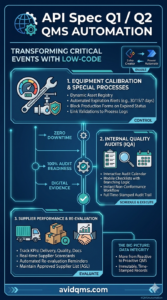
For an API Spec Q1 or Q2 organization, the “cost of poor quality” often stems from missed deadlines—a lapsed calibration, an overdue supplier re-evaluation, or a forgotten audit.
Low-code platforms like Zoho Creator and Microsoft Power Automate act as a digital “Quality Control Tower,” moving your QMS from reactive spreadsheets to proactive automation.
Here is how these tools transform critical compliance events:
🛠️ 1. Equipment Calibration & Special Processes
API Q1/Q2 requires strict control over measurement accuracy and process validation (Section 5.7.3).
The Automation: Instead of a static log, create a dynamic registry. Power Automate can trigger “Critical Alerts” to lab managers weeks before a gauge expires.
The Compliance Edge: Link your equipment database to production forms. If an operator tries to log a process using an expired tool or an unvalidated procedure, the system can block the entry entirely.
📋 2. Internal Quality Audit (IQA) Scheduling
Consistency is key to a healthy QMS.
The Automation: Use Zoho Creator to build an interactive Audit Calendar. Once an audit is scheduled, the system automatically sends invites to the auditors and notifications to the auditees.
The Compliance Edge: Auditors can complete checklists on mobile devices. Any “Non-Conformance” (NCR) automatically kicks off a Corrective Action workflow, ensuring no finding is left unaddressed before your next external API audit.
🤝 3. Supplier Performance & Re-evaluation
Maintaining an “Approved Supplier List” is only half the battle; the other half is the mandated periodic re-evaluation.
The Automation: Set up a dashboard that tracks supplier metrics (delivery time, NCRs, documentation accuracy). Power Automate can pull data from incoming receipts to calculate a real-time “Performance Scorecard.”
The Compliance Edge: Automated triggers notify your procurement team 60 days before a supplier’s certification or re-evaluation is due. This ensures your supply chain remains compliant without a manual paper chase.
The Big Picture: Data Integrity
The primary benefit of low-code in an API-certified environment is the digital audit trail. Every re-evaluation, calibration, and audit is time-stamped and archived. When the auditor asks, “How do you ensure your suppliers are still qualified?”—you don’t just tell them; you show them the automated evidence.
Are you still managing your QMS via spreadsheets, or have you moved to automated workflows?